Repair Guide
An online speaker cleaner is a browser-based tool that plays audio frequencies specifically tuned to vibrate your phone speaker and eject trapped water, dust, and debris from the speaker chamber — without any app download, account creation, or technical knowledge required. You open a website, press play, and the acoustic vibration does the work. This guide explains exactly how these tools work, what they can and cannot fix, and how to use one to get the best results.
Key Takeaways
- An online speaker cleaner plays specific frequencies through your phone browser — no app or download needed
- It works by vibrating the speaker membrane at amplitudes large enough to eject trapped water and dislodge debris
- Most effective for water-muffled speakers and reduced volume after moisture exposure
- Not a fix for hardware damage — a torn speaker cone cannot be repaired by any frequency
- Works on iPhone, Android, Samsung, Xiaomi, Redmi, OnePlus, Realme, Vivo, and any phone with a modern browser
- Apple Watch uses the same acoustic ejection principle in its built-in Water Lock feature
How Does an Online Speaker Cleaner Work?
Every phone speaker has a flexible membrane (also called a diaphragm) that vibrates to produce sound. A voice coil attached to the membrane responds to electrical audio signals — when current flows through it, the coil moves back and forth in a magnetic field, driving the membrane to push and pull air and produce sound waves.
When water enters the speaker grille and sits on this membrane, the water's weight and surface tension dampen the membrane's vibration, reducing volume and causing muffled, distorted audio. When dust or lint packs into the grille mesh, it physically restricts the sound from escaping the chamber.
An online speaker cleaner addresses both problems by playing low-frequency audio tones — most effective in the 165 Hz to 300 Hz range — through the speaker at volume. These frequencies drive the membrane to vibrate with larger excursion (movement amplitude) than normal music playback. This larger movement:
- Overcomes the surface tension of water droplets on the membrane and projects them outward through the grille
- Dislodges loosely settled debris from the membrane surface and grille mesh
- Clears the speaker chamber of blockages that are reducing sound output
This is the same physics principle behind Apple Watch's Water Lock, professional speaker maintenance equipment, and industrial ultrasonic cleaning — all use acoustic energy to displace matter from surfaces.
The Apple Watch Water Lock Connection
The most widely recognised example of acoustic speaker cleaning in consumer electronics is Apple Watch's Water Lock feature. After swimming, turning the Apple Watch's Digital Crown triggers a sequence of tones through the watch's tiny speaker. The tones drive the membrane to vibrate and eject water from the speaker grille — users visibly see and hear drops exit the speaker.
Apple officially describes this as using "acoustic outputs" to eject water. The same principle — calibrated frequency vibration driving water out of a sealed speaker chamber — is what browser-based speaker cleaners apply to phone speakers. SpeakerCure uses the Web Audio API to generate these tones directly in the browser, with no need for a dedicated hardware feature.
What Can an Online Speaker Cleaner Fix?
| Problem | Can Online Speaker Cleaner Help? |
|---|---|
| Speaker muffled after water exposure | Yes — this is the most effective use case |
| Reduced volume from dust or lint | Partially — effective for loose debris, less so for deeply compacted lint in the mesh |
| Crackling from moisture on the membrane | Yes — moisture causes crackling as the membrane vibrates against it |
| Speaker quiet after being dropped | Yes, if debris shifted inside the chamber during impact |
| Completely silent speaker at all volumes | No — silence typically indicates hardware damage or a software routing issue |
| Torn or blown speaker membrane | No — physical membrane damage requires hardware replacement |
| Audio routing software issue | No — Bluetooth/software causes need settings fixes, not acoustic cleaning |
How to Use an Online Speaker Cleaner for Best Results
The technique matters as much as the tool. Following these steps maximises effectiveness:
- Set volume to 80–90%. The frequency must be loud enough to drive significant membrane movement. At low volume, the excursion is too small to displace water. Do not use 100% — sustained maximum volume stresses the membrane's suspension unnecessarily.
- Hold the phone speaker-side down. On most phones, the loudspeaker is at the bottom edge. Tilt the phone so the speaker grille faces downward — gravity assists the ejection of water once the membrane vibrates it free.
- Run 2–3 sessions of 60–90 seconds each. A single 30-second pass is rarely enough for significant water exposure. Multiple sessions eject progressively more residual moisture.
- Watch and listen. You may hear a sputtering sound as water exits the grille. On a flat surface, small droplets may appear near the speaker. Both are confirmation it is working.
- Wipe the grille between sessions. Use a dry cloth to remove ejected water from around the speaker area after each session — preventing it from re-entering during the next session.
Online Speaker Cleaner vs. Other Methods
| Method | Effectiveness for Water | Time | Risk |
|---|---|---|---|
| Online speaker cleaner (acoustic) | High | 2–5 minutes | None |
| Rice method | Very low — cannot reach sealed chamber | 24–48 hours | Starch in ports |
| Hair dryer | Low — heat risk outweighs benefit | 5–10 minutes | Component warping |
| Silica gel | Low for speaker — absorbs ambient air only | 12–24 hours | None |
| Physical brush cleaning | Good for surface debris only | 5 minutes | Low (used gently) |
What Is SpeakerCure?
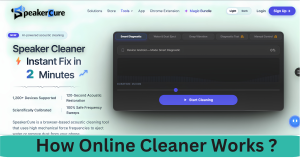
SpeakerCure is a browser-based acoustic cleaning and diagnostic tool that works on any phone or tablet with a modern browser — iPhone (Safari), Android (Chrome, Firefox), Samsung, Xiaomi, Redmi, OnePlus, Realme, Vivo, and any other device.
It runs in two modes:
- Water Ejection: A focused low-frequency pulse sequence tuned to expel water from the speaker chamber. Run this first if your speaker sounds muffled after water exposure.
- Diagnostic Test: A full frequency sweep from 100 Hz to 8,000 Hz that maps your speaker's response across the audio range — revealing dead zones, distortion peaks, and volume drops that indicate blockage or damage.
Both modes run entirely in the browser using the Web Audio API. Audio is generated locally on your device — it does not stream over the network, so it works on mobile data as well as Wi-Fi. No download, no account required for the core features.
Frequently Asked Questions
Does an online speaker cleaner actually work?
Yes — for water and debris-related speaker muffling. The acoustic principle has been validated by Apple in its Water Lock feature and is used in professional audio equipment maintenance. It does not work for hardware damage such as a torn speaker cone or a blown voice coil.
Is it safe to use an online speaker cleaner?
Yes. Playing frequencies at 80–90% volume for 2–5 minutes is well within the designed operating parameters of any modern phone speaker. Speakers are built for sustained high-volume audio — this is their normal use case. The only caution is against sustained 100% volume for extended periods, which is why 80–90% is recommended.
Will this work on my iPhone?
Yes. SpeakerCure and similar Web Audio API tools work on Safari on all iPhones running modern iOS. Open the tool in Safari, ensure volume is at 80–90% using the side buttons, hold the phone speaker-side down, and run the session.
How long should I run it?
For mild water exposure: 2 sessions of 60 seconds. For significant submersion or a drop in water: 3–4 sessions of 90 seconds each, spaced a few minutes apart. Wipe the speaker area with a dry cloth between sessions.
Can it remove dust as well as water?
Yes, partially. Acoustic vibration dislodges loosely settled dust from the membrane. For heavy compacted lint in the grille mesh, physical grille cleaning with a soft brush is more effective. Using both methods together gives the best results for debris-related volume loss.
Conclusion
An online speaker cleaner is the fastest, safest, and most accessible first response to a muffled or water-damaged phone speaker. No download, no technical skills, compatible with every modern phone. The acoustic principle is well-established — the same physics that Apple built into its Apple Watch Water Lock feature, applied to any phone speaker through the browser.
If your speaker sounds muffled, quieter than usual, or crackled after water exposure, run SpeakerCure now. It takes two minutes and works from your phone browser. If you want to check your speaker's full audio health, the Diagnostic Test sweeps from 100 Hz to 8 kHz and pinpoints exactly where your speaker is underperforming.