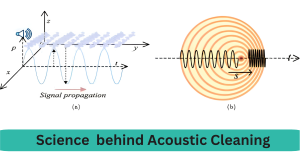
How It Works
Acoustic speaker cleaning uses precisely tuned audio frequencies to vibrate a phone speaker membrane and physically displace trapped water, dust, or debris from the speaker chamber — without disassembly or chemical treatment. The technique is grounded in established physics: mechanical resonance, acoustic pressure dynamics, and vibration engineering used in professional audio maintenance and consumer electronics waterproofing. This article explains the science in full — why specific frequencies are chosen, how the membrane displacement works, what the Apple Watch connection proves, and where the limits of the technique lie.
Key Takeaways
- Acoustic cleaning drives the speaker membrane at resonant frequencies to mechanically eject water and dislodge debris
- The effective frequency range for water ejection in phone speakers is approximately 165 Hz to 300 Hz
- Apple Watch's built-in Water Lock feature uses the identical acoustic ejection principle — validating the approach at a hardware level
- Ultrasonic cleaning in industrial settings uses the same physics at much higher frequencies (20–100 kHz) in liquid medium
- The speaker membrane's maximum excursion determines how effectively it can displace water droplets and debris
- Acoustic cleaning is effective for water and loose debris — it cannot repair torn membranes or correct electrical faults
How a Phone Speaker Works — The Physical Foundation
A phone loudspeaker is an electrodynamic transducer. A small coil of wire (the voice coil) sits in the gap of a permanent magnet. When electrical audio current flows through the coil, the interaction between the current and the magnetic field produces a mechanical force (the Lorentz force) that moves the coil back and forth in proportion to the audio signal. The coil is attached to the speaker membrane — as the coil moves, the membrane moves, pushing and pulling air to produce sound pressure waves.
The range of this membrane movement is called excursion. Larger electrical signals (louder volume) produce greater excursion. Lower frequencies produce slower, larger movements. Higher frequencies produce faster, smaller movements. This mechanical behaviour is the foundation of why acoustic cleaning works — and why specific frequencies are chosen over others.
The Physics of Acoustic Water Ejection
When water enters a phone speaker, it sits on and around the membrane. The water's surface tension and mass resist the membrane's vibration, reducing output and causing muffled, distorted audio.
To remove water without disassembly, acoustic cleaning drives the membrane at frequencies where three conditions are simultaneously met:
- Excursion is large enough to overcome the water droplet's surface tension and inertial resistance at the membrane surface
- Membrane acceleration is high enough to project the water droplet outward through the speaker grille openings against gravity
- The frequency is low enough that the full membrane moves as a unified unit — at higher frequencies, the membrane flexes in sections (called "break-up modes") which reduces the effective ejection force
The 165 Hz to 300 Hz range satisfies all three conditions for standard phone loudspeaker configurations. This is low enough for significant membrane excursion, while high enough that the back-and-forth acceleration provides enough kinetic energy to overcome surface tension and project water out through the grille mesh.
Orienting the phone speaker-side down during acoustic cleaning adds gravity to the ejection vector — water is accelerated downward and outward rather than back into the chamber, improving ejection efficiency significantly.
The Apple Watch Water Lock Validation
The most widely recognised consumer-electronics validation of acoustic speaker cleaning is Apple Watch's Water Lock feature, introduced with watchOS 2 in 2015 and present in every Apple Watch model since.
When a user activates Water Lock (or the watch detects it was submerged), turning the Digital Crown triggers a sequence of tones through the watch's loudspeaker. These tones drive the membrane to vibrate and eject water from the speaker chamber — the watch owner hears a short audio burst and sees water drops exit the speaker grille.
Apple's engineering team documented this as using "acoustic outputs" to eject water, confirming that calibrated acoustic frequency vibration is an effective, hardware-safe method for water ejection from sealed speaker assemblies. The physics is identical to browser-based speaker cleaning tools — SpeakerCure uses the Web Audio API to generate the same type of tones for phone loudspeakers, which have larger membranes and greater excursion capacity than Apple Watch's tiny driver.
How Ultrasonic Cleaning Validates the Broader Principle
Industrial ultrasonic cleaning — used for electronics circuit boards, surgical instruments, and precision mechanical parts — operates on the same fundamental principle at much higher frequencies (20,000 to 100,000 Hz, above the range of human hearing).
At ultrasonic frequencies in liquid, acoustic pressure waves create and collapse microscopic bubbles — a process called cavitation. The implosion of these bubbles produces localised high pressure that dislodges contaminants at a microscopic scale.
Acoustic speaker cleaning in the audible range does not produce cavitation — the medium is air, not liquid, and the frequencies are too low. Instead, it relies on inertial displacement: the membrane's rapid directional movement overcomes surface tension and adhesion, physically throwing water or debris out of the chamber. The mechanism differs from ultrasonic cleaning, but the underlying principle — using acoustic energy to displace matter from a surface — is shared and well-established across both methods.
Why Volume Level Matters for Effectiveness
Acoustic cleaning only works when the membrane moves with sufficient amplitude to displace the target material. Membrane excursion is directly proportional to the audio volume — the electrical signal amplitude driving the voice coil.
At low volumes (below 50%), excursion is too small. The membrane vibrates but cannot generate sufficient acceleration to overcome a water droplet's surface tension or dislodge debris adhesion.
At 80–90% volume, excursion is large enough to be effective, while remaining well below the mechanical limits of the speaker's suspension system. At 100% sustained volume, the voice coil reaches the edge of its designed travel range (the xmax specification) — sustained operation here increases wear on the spider and surround suspension components over time.
The 80–90% range is the engineering optimum: effective for ejection without exceeding speaker design limits.
The Frequency Diagnostic Principle
In addition to cleaning, frequency sweeps are used diagnostically to map a speaker's acoustic response curve. A healthy phone speaker produces relatively even output across its frequency range. Blockages, damage, or moisture affect specific frequency ranges in identifiable patterns:
- Amplitude drops at specific frequencies — the membrane is experiencing interference (water, debris) that dampens vibration at those particular resonances
- Distortion peaks at specific Hz — the frequency range where blockage or damage is most mechanically significant, producing crackling or buzzing at those resonant points
- Complete silence in a frequency band — severe blockage preventing membrane movement, or membrane failure at that resonant zone
This diagnostic sweep approach — a standard technique in professional audio engineering called "frequency response measurement" — is what SpeakerCure's Diagnostic Test applies to phone speakers in an accessible browser-based form, sweeping from 100 Hz to 8,000 Hz to map the full acoustic response of the speaker in real time.
What Acoustic Cleaning Cannot Do
Understanding the technique's limits is as important as understanding its capabilities:
- Cannot repair physical membrane damage: A torn, creased, or delaminated membrane vibrates in a distorted pattern regardless of input frequency. Acoustic energy cannot restore structural integrity to a damaged diaphragm.
- Cannot remove deeply embedded debris: Particles that have penetrated behind the membrane into the motor structure (around the voice coil and magnet gap) are beyond the reach of air-medium acoustic displacement.
- Cannot correct electrical faults: Failed voice coils, damaged amplifier circuits, or broken solder connections require electronic repair — acoustic inputs have no effect on electrical component states.
- Cannot fully dissolve mineral deposits: Calcium, magnesium, and silica deposits from evaporated hard water bond chemically to the membrane surface. Acoustic vibration can dislodge loose mineral particles but cannot break chemical bonds — professional ultrasonic cleaning in liquid medium or chemical treatment is required for advanced mineral contamination.
Frequently Asked Questions
What frequency removes water from phone speakers?
The most effective range is approximately 165 Hz to 300 Hz. This produces large membrane excursion sufficient to overcome water surface tension while keeping the speaker within its linear operating range. The exact optimal frequency varies slightly by phone model, speaker diameter, and membrane stiffness coefficient.
Is acoustic speaker cleaning safe?
Yes. Operating at 80–90% volume for 2–5 minutes is well within the designed operating parameters of any modern phone speaker. Speakers are engineered to handle sustained high-volume audio — this is their normal operating condition. The only caution is against sustained 100% volume for extended periods.
How does Apple Watch Water Lock work?
Apple Watch Water Lock plays a sequence of tones through the watch's loudspeaker when activated. The tones drive the speaker membrane to vibrate at controlled frequencies that displace water through the grille openings. Apple officially describes this as using acoustic outputs to eject water — the same principle used by SpeakerCure and similar browser-based tools, scaled to phone speaker dimensions.
Can sound waves damage a phone speaker?
Audio frequencies within the speaker's designed operating range do not damage the hardware. Damage occurs from sustained operation beyond the mechanical travel limit (xmax) of the suspension system — typically requiring prolonged operation at 100% volume. Acoustic cleaning sessions at 80–90% volume for 2–5 minutes do not approach this threshold.
What is the difference between acoustic cleaning and ultrasonic cleaning?
Both use acoustic energy to dislodge matter from surfaces, but operate in different media via different mechanisms. Acoustic cleaning for phone speakers operates in air at audible frequencies, relying on membrane inertial displacement. Ultrasonic cleaning operates in liquid at frequencies above 20 kHz, relying on cavitation. Ultrasonic cleaning is more powerful for deeply bonded contaminants but requires submerging the object in liquid — impractical for phones in active use.
Conclusion
Acoustic speaker cleaning is grounded in well-established physics: resonant frequency vibration, inertial displacement, and membrane excursion dynamics. The 165–300 Hz range is effective for water ejection because it maximises membrane movement amplitude while keeping the speaker in its linear operating zone. Frequency sweeps extend the same principle into diagnostics, mapping the speaker's full response curve to identify where blockage or damage has affected output. Apple's Water Lock feature validates the acoustic approach at a commercial hardware level — the same physics works for phone speakers through any browser.
For practical use, SpeakerCure applies both acoustic cleaning and frequency diagnostics to any phone in under two minutes, directly from the browser. No download, no installation — the same acoustic principle, applied immediately.